Molokini is the one snorkel spot almost everyone has heard of before they land, and there are more than a dozen boats that go there. They are not interchangeable. Some leave at dawn from a harbor, some leave at mid morning from a boat ramp, some carry 150 people and some carry 19. The right choice depends less on which company has the best reviews and more on what kind of morning you want.
This guide lays out the real differences, explains why our pick is the Molokini snorkeling raft tour. If you already know you want a big boat with breakfast and a waterslide, that is a fine choice too, and we say so below.
What Molokini is and why the boat matters
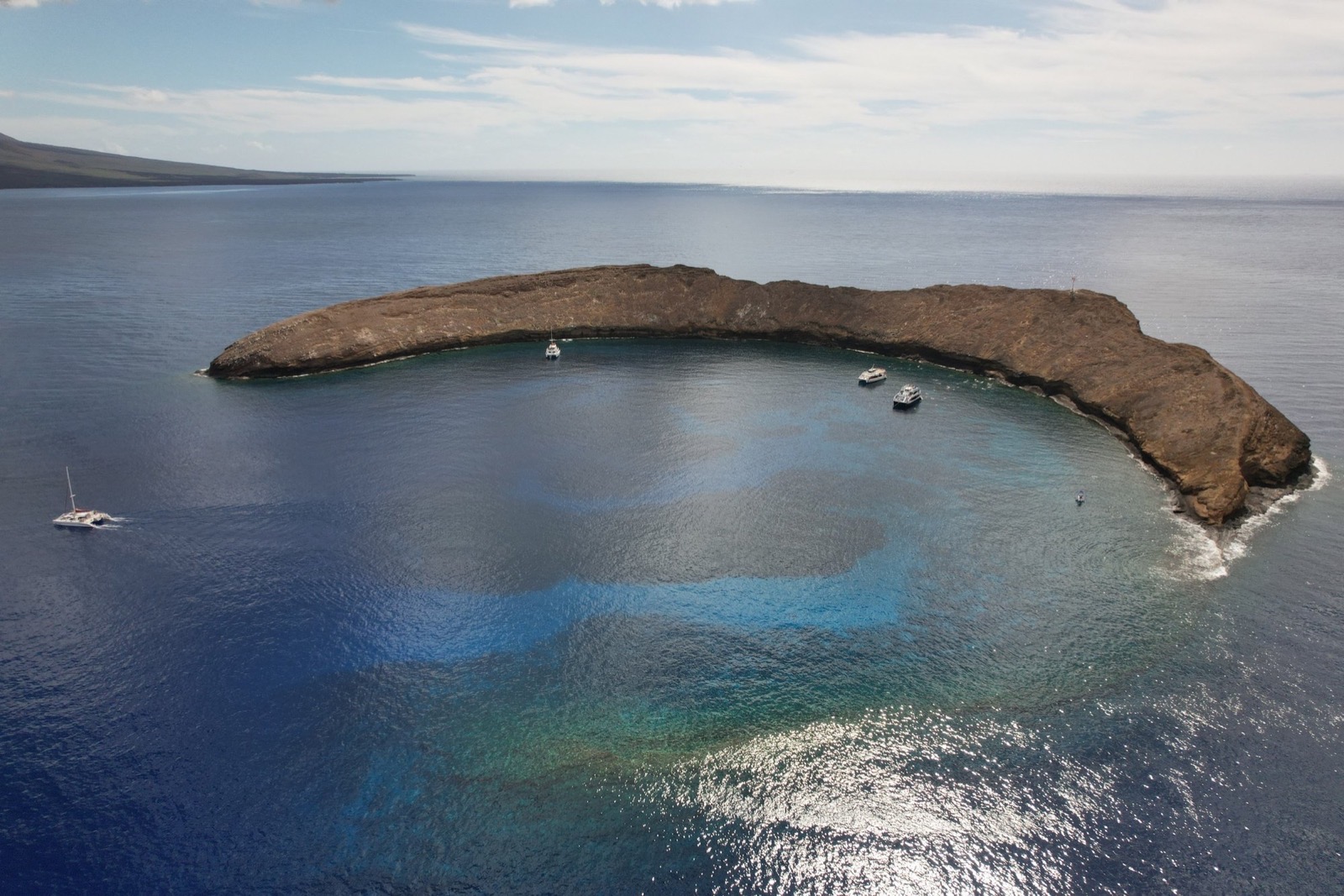
Molokini is a crescent-shaped volcanic crater about three miles off Maui’s south shore. Only the rim breaks the surface, and the curve of that rim creates a sheltered bay with visibility that often reaches 100 feet. It is a marine life conservation district, so the fish are abundant and not afraid of people.
Two things make the boat choice matter. First, the crater is small and the state limits moorings inside it, so a big boat is sharing the water with other big boats. Second, the wind. Trade winds build through the morning on the south coast, and by late morning the ride across the channel gets choppy and the water inside the crater gets a little bumpier. That is why most of the catamarans leave early and why the rafts, which cross the channel in 20 minutes, can afford to leave later.
The two camps: rafts and catamarans
Every Molokini boat falls into one of two groups.
Big catamarans carry anywhere from 60 to 150 guests. They have restrooms, shade, a galley that serves breakfast and lunch, and a stable platform that handles chop well. They take four to five and a half hours, and most include a second stop at Turtle Town, a stretch of reef off Makena where green sea turtles feed.
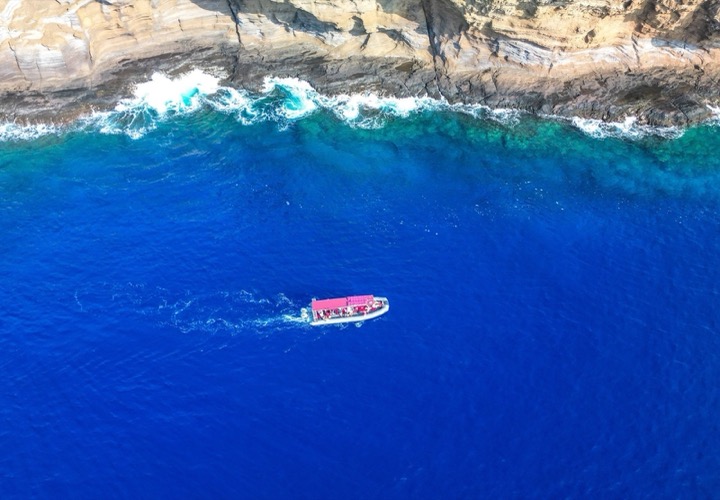
Rafts are rigid-hull inflatables, usually 35 to 40 feet long, carrying 15 to 24 guests. They are fast, low to the water and open to the spray. Trips run from two to five hours depending on how many stops are included. There is no restroom on board, and you board and exit the water by a ladder.
Neither is better in the abstract. A catamaran is the right call for grandparents, for anyone who gets seasick, for groups with small children, and for people who want to eat a meal on the water. A raft is the right call for confident swimmers who want the most water time per hour, who do not care about a buffet, and who would rather have 19 people around them than 140.
The departure points
Three places on the south side send boats to Molokini, and where you leave from changes the length of the ride and the feel of the morning.
Maalaea Harbor is the commercial harbor at the bottom of the isthmus, about 20 minutes from Kahului airport and 25 minutes from Kaanapali. It is where the big catamarans dock. The run to Molokini takes 45 minutes to an hour, which is why these boats serve breakfast on the way out.
Kihei Boat Ramp is a public launch ramp at the south end of Kihei, next to Kamaole III beach park. It is where the rafts leave from. The run to Molokini takes 15 to 25 minutes. There are restrooms and showers at the ramp, which matters because the rafts do not have either. Parking is free but fills up by mid morning.
Makena is the farthest south and the closest to the crater. One catamaran loads from the sand in front of the Makena resort, and from there Molokini is about a 20-minute sail. That is the shortest ride of any big boat.
If you are staying in Wailea or Kihei, all three are 5 to 20 minutes away. If you are staying in Kaanapali or Kapalua, plan on 40 to 50 minutes to Kihei and 25 to 35 minutes to Maalaea, and remember that a 7 am check-in at Maalaea means leaving the west side before 6:15.
Morning versus late morning
Here is the trade-off nobody puts on the brochure.
The earliest boats, with check-ins between 6 and 7 am, get the calmest water and the clearest visibility. They also get the crater before the bulk of the fleet arrives. The cost is a very early alarm, and if you are coming from West Maui, a drive in the dark.
The mid-morning boats, with check-ins between 9:30 and 10:30, let you eat breakfast at your condo, drive in daylight and still have an afternoon. Visibility is usually still excellent. The channel is bumpier on the way out, and on a windy day the captain may call Turtle Town or a coastal site instead of the crater.
Most catamarans run one Molokini trip a day in the early slot, with afternoon trips going to nearer reefs. The rafts stagger their departures from 7 am to 10:30 am, which is where a late-morning raft becomes a useful option: it is the only way to get a true Molokini snorkel without a dawn start.
The operators, one by one
These are the boats people ask about most. Prices and schedules change, so treat the details as a starting point and confirm on each operator’s own site.
The biggest Maalaea catamaran
A large double-decker catamaran out of Maalaea with room for well over a hundred guests. The morning trip is around five hours and covers Molokini and Turtle Town, with a continental breakfast and a barbecue lunch, an open bar after the last snorkel stop, a waterslide, and SNUBA as an add-on. It is a good fit for a mixed group where some people snorkel and some people sit on the top deck with a drink. The scale is the drawback: a lot of people in the water at once.
The glass-bottom Maalaea catamaran
Maui Classic Charters’ 55-foot glass-bottom catamaran, also from Maalaea. The morning trip spends its whole snorkel time at Molokini rather than splitting it with Turtle Town, which many guests prefer. There is a waterslide, a glass viewing window for non-swimmers, breakfast and a barbecue lunch, and the crew is well regarded for working with nervous first-time snorkelers. It carries fewer people than the biggest boats, and it is often the better value among the catamarans.
The naturalist-run harbor boats
A nonprofit that runs a fleet of catamarans from Maalaea. Their Molokini trips put a certified naturalist on board and build education into the day, which is a real plus with kids. They offer several lengths, including a Molokini and Turtle Town combination and a longer version with a third stop. The boats are large and the operation is efficient rather than intimate, but the science angle is genuine and the crews are good.
The Makena sunrise catamaran
The one that loads from the beach at Makena. Because it is so close to the crater, the Makena boat can run a sunrise trip that reaches Molokini before anyone else and is back by mid morning. The boat is a luxury catamaran with a smaller guest count than the Maalaea fleet, and the pricing reflects that. If you are staying in Wailea or Makena and want the first look at the crater with a hot breakfast, this is the premium option.
The back-wall raft
A raft operator out of the Kihei Boat Ramp. Their signature trip is a long morning that covers the inside of Molokini, the back wall of the crater (a sheer drop-off that only rafts visit), the Kanaio coast lava cliffs south of Makena, and Turtle Town. It starts around 7 am and runs about five hours, with breakfast and a deli lunch. It is the most adventurous Molokini trip on the island and the one to pick if you want to see the dramatic side of the crater.
The express raft
Another Kihei Boat Ramp raft company, known for the Kanaio coast trip along the sea caves and lava arches south of La Perouse Bay. They also run a shorter Molokini express that gets you to the crater, into the water and back in about three hours. Boats are smaller than the back-wall raft’s, and the captains are known for lively narration.
The late-start raft (our pick)
The raft we recommend. Their two-hour trip checks in at 10 am at the Kihei Boat Ramp, departs at 10:30 sharp, reaches the crater in 15 to 20 minutes and spends more than an hour in the water. There is no breakfast and no second stop, just a 40-foot raft, a maximum of 19 guests, good gear, snacks and juice afterward, and a 4.8 rating across more than 1,100 reviews. A three-hour version adds Turtle Town. Both run April 1 to December 14.
Why the late-start raft is our pick
We compared the options on four things: how much of the trip is spent snorkeling, when you have to wake up, how many people are in the water with you, and what guests say afterward.
The two-hour raft wins on the first three for most visitors. More than an hour in the water out of a two-hour trip is a better ratio than any catamaran manages, since the big boats spend an hour or more in transit each way. The 10:30 departure is the latest Molokini start of any operator, which matters for anyone staying in West Maui or anyone traveling with a body clock that does not want a 5 am alarm. And 19 guests inside a crater is a different experience from 140.
It is also honest about what it is not. The ride is wet and bumpy. There is no restroom on board. Ages are 5 to 65, the weight limit is 300 pounds, pregnant guests cannot ride, and you need to be able to climb a vertical ladder. Non-swimmers should choose a catamaran, full stop.
If those limits rule you out, the glass-bottom catamaran is our suggestion among the big boats, because it spends its whole morning at the crater and the crew is patient with beginners. If you want the drama of the back wall and the lava coast, the back-wall raft is the one.
How to pick in 60 seconds
- Confident swimmers who hate early alarms: the 2-hour late-start raft.
- Want turtles as well as the crater: the 3-hour turtle combo, or the glass-bottom catamaran if you prefer a big boat.
- Grandparents, small kids or seasick-prone travelers: the big Maalaea catamarans.
- Big mixed group, some snorkelers and some sunbathers: the biggest Maalaea catamaran.
- Staying in Wailea and want the sunrise premium version: the Makena sunrise catamaran.
- Want the back wall and lava coast: the back-wall raft.
- Short on time but want a raft: the express raft.
Seasons and conditions
The rafts generally run from spring through mid December. Our pick runs April 1 to December 14, and the thrill-craft rules that pause parasailing and jet skis from December 15 to May 15 also shape what the small boats can do in winter. The catamarans run year round and switch to whale watching from December 1 to April 30, when a Molokini morning in winter often includes a humpback sighting on the crossing.
Summer is the most reliable season for Molokini. The trades are steady but the south coast is sheltered, and visibility is at its best. Late fall and spring are good too. In winter, a big north swell does not affect Molokini much, but a south or Kona wind does, and that is when trips get moved to Turtle Town.
Every operator reserves the right to change the site. Book Molokini early in your trip so you have a day to reschedule if the ocean does not cooperate.
If you are staying in West Maui
A Molokini morning from Kaanapali means a 40 to 50 minute drive each way, which is fine once but not something you want to do twice. If a long south-side day does not fit, the West Maui snorkel tour boards right off Kaanapali Beach, visits two reef sites and includes breakfast and lunch, and the afternoon snorkel tour from the same beach is a good turtle trip that leaves after lunch. Neither goes to Molokini, but both save you the drive, and on the West side the turtles are easier to find.
For how the regions fit together, our Maui island map and regions page has drive times from each resort area to every departure point.
Pairing Molokini with the rest of the trip
Molokini is a two-hour morning, which leaves the rest of the day open. On the south side, the Haleakala bike tour checks in at Paia 35 to 40 minutes from Kihei, so some visitors do the bike ride one morning and the crater the next. The private Road to Hana tour picks up at any hotel. Back on the west side, the ATV tour above Lahaina is a good muddy contrast to a morning in clear water, and the sunset dinner cruise or sunset cocktail cruise off Kaanapali Beach is the easy way to end a Molokini day. In winter, when the rafts pause, the whale watching raft from Kaanapali is the small-boat trip that takes its place.
Quick answers
Is Molokini worth it?
Yes, at least once. The visibility and the sheer number of fish are unlike any shore snorkel on Maui. Whether it is worth a five-hour catamaran day or a two-hour raft is the only real question.
Which is better, morning or afternoon Molokini?
Morning, always. Almost no boats go to the crater in the afternoon because the wind picks up. Late morning on a raft is the latest practical option.
Can non-swimmers go to Molokini?
Yes, on a catamaran. The glass-bottom boats and the big decks give non-swimmers plenty to do, and flotation gear is standard. Rafts are for swimmers only.
Can kids go?
On most catamarans, yes, at any age. The late-start raft takes ages 5 to 65. For more on ages across every adventure, see our guide to Maui with kids.
How far ahead should I book?
A week or two is enough most of the year. In late December, February, March and June through mid August, book before you fly.
The bottom line
Pick the boat by the morning you want, not by the logo. Early and comfortable with a meal means a Maalaea catamaran. Late, quick and in the water the longest means the late-start raft. Adventurous and all day means the back-wall raft. For everything else to do on the island, our best things to do in Maui guide covers the rest.
Written by West Maui locals with 25 years in Maui water sports. How we make money.